Video creative audit · original fictional example

The Lunch You Actually Eat

A complete report example showing how a short routine script becomes a timeline of creative choices, source-linked findings and practical next tests.

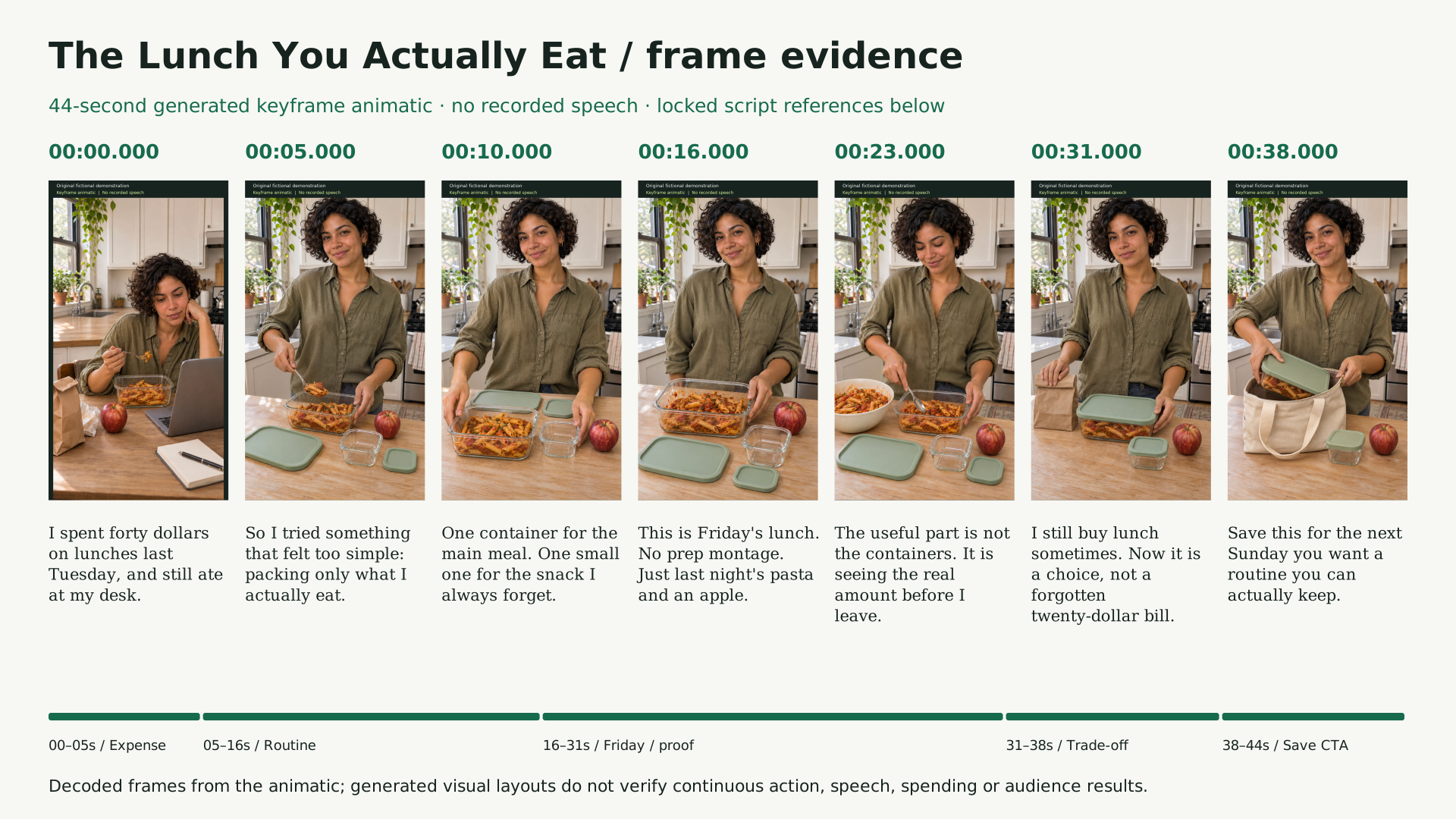
Seven decoded Lunch animatic frames at the locked timestamps, with five original beats.
Generated keyframe animatic · script/planned voiceover, not recorded narration or a physical demonstration. · Full size ↗

Script / planned voiceover

Read the script before the interpretation.

The underlying example is a generated keyframe animatic with no recorded narration or continuous physical performance. It is presented here as an inspectable storyboard rather than a finished commercial.

Evidence boundary
Script lines are planned voiceover, not Heard audio. Generated frames are marked Seen only for what is visible in this fictional animatic; they do not validate real portions, spending, actions or product results.
01

00:00 I spent forty dollars on lunches last Tuesday, and still ate at my desk.

02

00:05 So I tried something that felt too simple: packing only what I actually eat.

03

00:10 One container for the main meal. One small one for the snack I always forget.

04

00:16 This is Friday's lunch. No prep montage. Just last night's pasta and an apple.

05

00:23 The useful part is not the containers. It is seeing the real amount before I leave.

06

00:31 I still buy lunch sometimes. Now it is a choice, not a forgotten twenty-dollar bill.

07

00:38 Save this for the next Sunday you want a routine you can actually keep.

Generated storyboard · 8 keyframes

Inspect the intended visual sequence.

Move through each planned beat and its timestamp. These stills show intended composition, not continuous acting, lip-sync or a real product demonstration.

Fictional example · editorial sampleNov 9, 2026

Editorial verdict

Useful structure — the animatic clarifies the proof to film

A practical routine concept built around a specific weekly spending pain. A generated keyframe animatic maps the planned visuals, including a portion comparison, but there is no recorded narration or continuous physical demonstration. The honest trade-off near the end remains the strongest creative choice.

Logline

A realistic packing routine turns an automatic daily expense into a deliberate choice.

What is worth keeping

  • The opening combines a concrete amount, a specific day and a recognizable situation.
  • The script rejects the expected prep montage, making the routine feel achievable rather than aspirational.
  • The closing CTA asks for a save that matches the practical value of the video.

Revision priorities

3 findings
01
majorProof

The animatic maps the proof, but a real demonstration is still needed.

Source text00:23 · planned voiceover
“The useful part is not the containers. It is seeing the real amount before I leave.”
Seen00:23 · generated animatic frame
“Generated keyframe: pasta, an apple and containers arranged for a portion comparison.”
Observation
The planned voiceover says that seeing the real amount is the useful part. At 00:23, a generated keyframe shows pasta, an apple and containers arranged for a portion comparison.
Interpretation
The storyboard layout makes the intended mechanism easier to understand, but it does not verify a real packing action, physical portions or the claimed expense.
Why it matters
The visual intent is clearer, while the evidence required for a finished demonstration remains unavailable.
Revision action
Treat the keyframe as a shot plan. Record the actual meal and forgotten snack beside it, hold the comparison long enough to be understood, and keep that physical demonstration distinct from this generated example.
02
minorHook

The opening is specific but delays the creative angle.

Source text00:00 · planned opening line
“I spent forty dollars on lunches last Tuesday, and still ate at my desk.”
Observation
The first line establishes expense; the portion-control angle arrives five seconds later.
Interpretation
The money hook and the routine solution are related, but viewers may expect a budgeting video rather than a realistic meal routine.
Why it matters
The audience promise can feel broader than the content that follows.
Revision action
Test an opening that joins the cost and the portion insight in one sentence, while preserving the concrete forty-dollar detail.
03
preferenceCTA

The save request is relevant; a comment prompt could test the honest trade-off.

Source text00:38 · planned CTA
“Save this for the next Sunday you want a routine you can actually keep.”
Observation
The closing asks viewers to save the routine for Sunday.
Interpretation
The line about still buying lunch creates an opportunity for viewers to share their own realistic boundary.
Why it matters
A save supports utility, but may not reveal whether the trade-off is the message people remember.
Revision action
Keep the save CTA as the control. Test a separate version asking what viewers actually pack, rather than adding both prompts to one ending.

Craft dimensions

strengthHook

Specific cost and occasion create immediate context.

strengthAudience tension

The script addresses unrealistic routines as well as spending.

strengthMessage

One central mechanism: pack for actual behavior.

reviewProof

A portion layout is visible in the generated animatic; a real physical demonstration has not been verified.

strengthPacing

A new idea arrives in each short beat.

strengthCTA

The requested action matches a reusable routine.

Creative timeline

00:00
Specific expense hook

A concrete pain before the solution.

Forty dollars on lunches, still eaten at a desk.
00:05
Realistic routine

The mechanism is behavioral rather than a product claim.

Pack only what you actually eat.
00:16
Friday demonstration

A generated keyframe maps the intended comparison; it is not a physical demonstration.

Pasta, an apple and a visible portion.
00:31
Honest trade-off

A limitation increases credibility.

Buying lunch remains a choice.
00:38
Save CTA

The action matches future utility.

Save for Sunday.

Analysis limits

  • This is an original fictional example, not a customer result.
  • The source is a generated keyframe animatic with no recorded speech or continuous physical performance; script lines are planned voiceover, not Heard evidence.
  • Decoded frames verify storyboard layouts only, not physical portions, spending or real actions; sampled frames are not exhaustive shot detection.
  • No retention, CTR, conversion or ROAS data was supplied.

Suggested next step: Record the real portion comparison and review it against the animatic. Test the revised opening and the comment CTA separately from the controls.

Continue learning

Turn the example into your own workflow.

These guides connect the creative method to a complete example and a working analysis workflow.

Practical guide

Evaluate a 30-second ad hook and pacing

Map the opening promise, proof, information change and CTA to the real timeline.

Read the guide →
Practical guide

Turn a reference video into an original script

Transfer a creative mechanism without copying the reference wording, performance or claims.

Read the guide →